
欽哲基金會
Khyentse Foundation
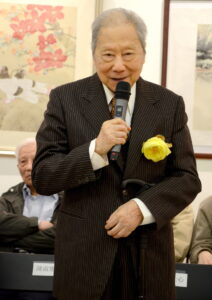
Professor Johnson Chow Su-Sing
While there is an end to life, there are no boundaries in art.’ This statement summarises Professor Johnson Chow Su-Sing’s lifelong artistic philosophy. Chow began painting at the age of eight and has assiduously continued his artistic pursuit for nearly ninety years. A key figure in the heritage of Wu School Chinese painting, Chow was born in SuZhou, a city favoured by literati painters in the past. Supported by his father. Zhou Chilu (1889-1966) who encouraged him to draw, his uncle, Zhou Mutian who taught him poetry, verses and the art of calligraphy, and his brother, Zhou Yujing who instructed him in the skills of bamboo and seal carving, the young Chow thrived as a prodigy in the fundaments of Chinese art. Furthermore, the young artist was accepted to study with local masters; the painting of flowers with Wu Silan (1908-1964), the details of depicting fruit and vegetables with Liu Junran (1901-1987), as well as birds and insects with Zhang Xingjie (1909-1991). In his spare time, Chow visited Wu Silan’s studio which housed a rich collection of paintings by old masters, providing him with a valuable opportunity to further his knowledge of Chinese art history. Chow graduated from SuZhou Fine Arts College in 1944, at the age of twenty-one. To evade the war, he left his home in 1949 and eventually settled in Hong Kong. At that time, many artists from the north of China and abroad took refuge in Hong Kong. While there, Chow met a number of acclaimed masters and fortuitously furthered his learning.
In the 1950s, Chow met Zhang Daqian (1899-1983) and they later became close friends. He once visited Zhang’s studio, DafengTang, where he was exposed to calligraphic works and large paintings of lotus by Bada Shanren (1626-1705). The visit inspired him to conduct an in-depth study of the art of Bada Shanren. It was also under the influence of Zhang that Chow went on to paint landscapes in splashed ink and free style. Combining both the traditional methods of Chinese painting and the spirit of Chinese culture, Chow developed a form of self-expression with graceful and forceful brushwork. His efforts opened a new vein of ink painting.
Chow twice taught at the Department of Fine Arts of New Asia College, The Chinese University of Hong Kong; in the 1960s, and in the 1990s. His teaching principle demonstrated a profound influence on the younger generation, in which he stressed that they should study broadly, observe more, practise hard and learn from others, while being courageous enough to surpass the old and achieve their own artistic style.
Chow moved to the United States in 1971 and has been living in Canada since 1980. During his sojourn in foreign lands, the artist travelled far around the world, exploring great mountains and rivers and experiencing the indigenous customs of different regions in the West, from which he drew inspiration for his works. He learned from ancient masters and from nature, adopting a creative approach to his landscape paintings, among which The Rocky Mountains, Canada, The Grand Canyon, and Iguazu Falls, Brazil marked the pinnacle of his artistic career. In the 1980s, Chow revisited China and travelled to Huangshan. Overwhelmed by the magnificent scenery, he created the Three Gorges and Two Shores series, the Huadong series and the Huangshan series. Although living in North America, Chow has not ceased promoting Chinese art and culture. His dedication to the subject encompasses a range of activities, including exhibiting, demonstrating, writing and lecturing at colleges and universities. His teaching has resulted in many followers of his art around the world. Moreover, Chow founded the Chinese Canadian Artists Federation in Vancouver and was elected the first president.